
OMOP Standardisation
A common language for Singapore's health research data
Deploying OMOP
A high-level guide to taking your cohort from raw data to the OMOP Common Data Model
OMOP Concept Search API
Look up Singapore OMOP concepts from your own systems
OMOP Frequently Asked Questions
Answers about OMOP, the Singapore harmonised OMOP vocabulary, OMOP Concepts Search, the API, deploying OMOP and the Community of Practice
Using OMOP Concepts
Find the right standard concept for each of your local variables
Singapore's first harmonised OMOP vocabulary is now available to TRUST members through OMOP Concepts Search in the TRUST Metadata Catalogue. Built together with the research ecosystem, it gives every programme a common starting point for mapping cohort data to the OMOP Common Data Model. Search by concept name, concept ID or local variable name to see a concept's domain, its source vocabulary and the Singapore cohort variables already mapped to it.
Teams building ETL pipelines can query the same index from their own systems through the OMOP Concept Search API, using a key generated in the members' portal. To go further, join the Singapore OMOP Community of Practice in the enTRUST members' portal, where programmes share mappings, local code lists, tools and lessons learnt, so that each new cohort builds on what the last one solved.
What is OMOP?
The OMOP Common Data Model (CDM) is an open, international standard for organising health data. It is maintained by OHDSI, a global research community, and is used by health systems and research programmes worldwide.
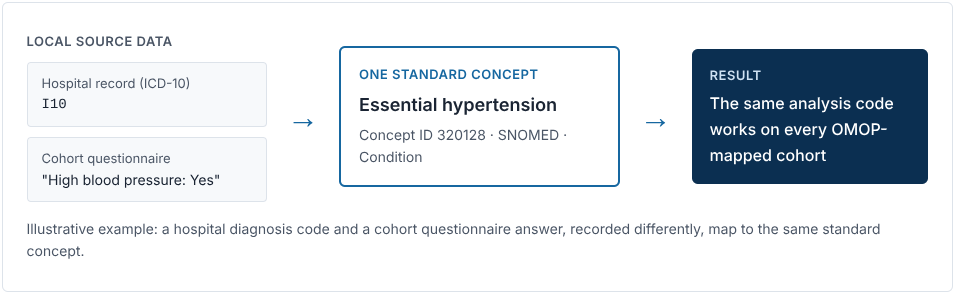
Different institutions record the same clinical idea in different ways. OMOP maps each local code to one standard concept, so the same question can be asked of every dataset with the same analysis code.
Learn more about the OMOP CDM at OHDSI (opens in new tab)
Why Singapore is adopting OMOP
For data to support good research, it must be trustworthy, and standardisation is a big part of data quality. When institutions represent the same clinical concepts consistently, analyses become comparable, methods can be reused and collaboration becomes easier. In 2022, TRUST adopted the OMOP CDM as its standard for clinical and health data. Our goal is for OMOP to become the default for research cohorts in Singapore where relevant, so that data is increasingly analysis-ready from day one.
One national standard
Research cohorts mapped to the OMOP CDM using the shared Singapore harmonised vocabulary.
Consistent mapping depth
A common baseline of core domains (person, visit, condition, drug, measurement) mapped and quality-checked to an agreed level.
Reusable analysis
Cohorts that can be queried with the same analytical code across programmes, without re-cleaning data.
A national shared asset
The vocabulary, guides, NDCT expertise and training, so every programme can map and sustain OMOP.
Our journey so far
TRUST chooses OMOP
OMOP CDM is selected as TRUST's standard for clinical and health data.
Building nationally
National Data Curation Team set up under A*STAR BII to build capability, guides and workflows.
Bringing teams together
Collaboration established amongst GUSTO, ATTRaCT, STCC, SingCloud, SG100K, SingHealth and NUHS.
Sharing what works
A harmonised vocabulary, guides and a Community of Practice.
Singapore's harmonised OMOP vocabulary
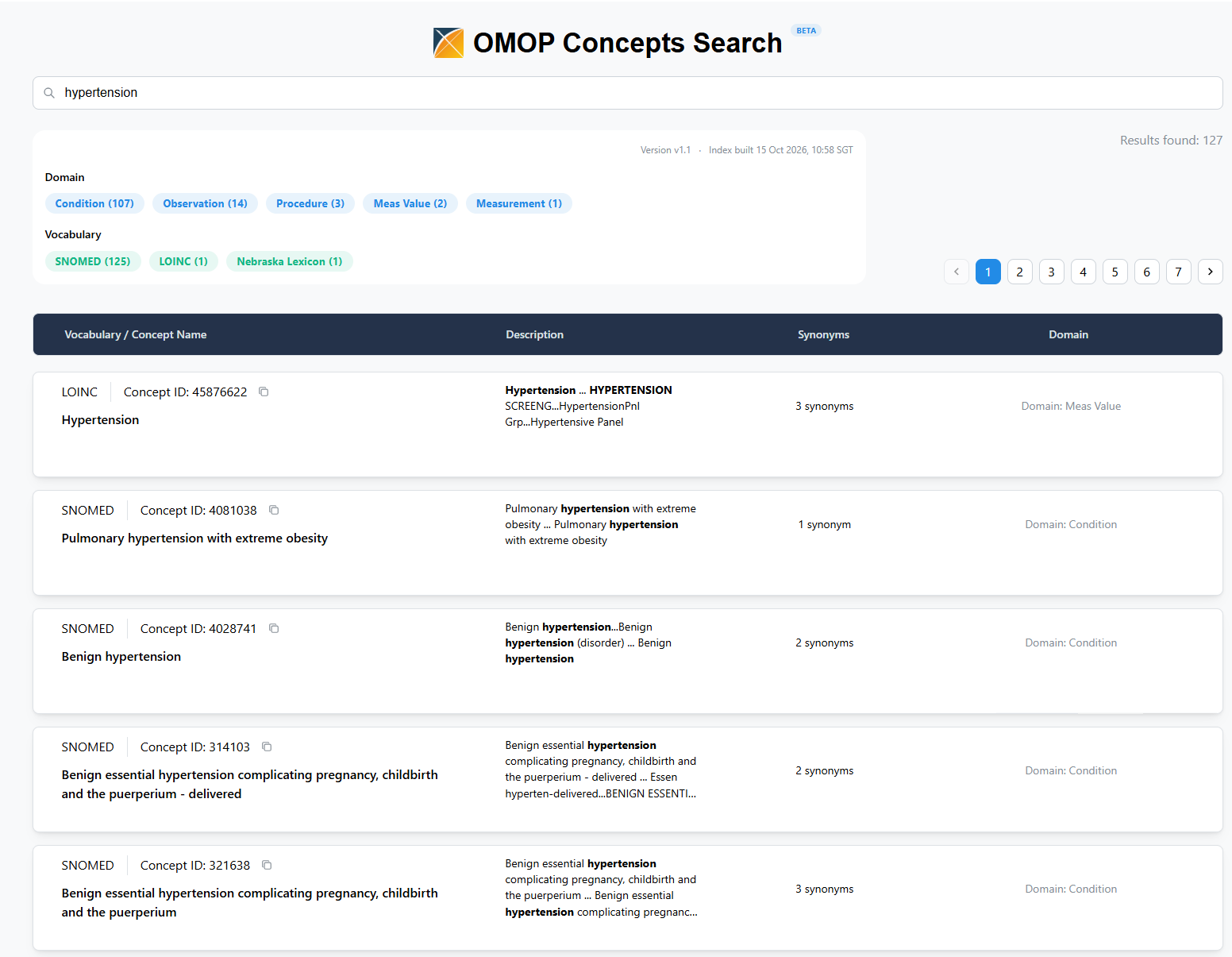
Singapore's first harmonised OMOP vocabulary was built together with the ecosystem and is available to TRUST members through OMOP Concepts Search in the TRUST Metadata Catalogue. Use it to:
search by concept name, concept ID or local variable name
filter results by OMOP domain and source vocabulary
see which Singapore cohort variables already map to each concept
OMOP Concept Search API
Look up concepts from your own mapping and ETL pipelines. The API searches the same concept index as OMOP Concepts Search, so your scripts and your team see the same results.
It suits teams with many variables to map or who want concept lookups built into a data pipeline. TRUST members can generate an API key in the members' portal.
Get started
If you own or run a cohort, here is how to plug in
Start your OMOP journey
Map your cohort using the harmonised vocabulary, guides and workflows, so you don't build from scratch.
Tap NDCT expertise
Bring mapping, ETL and data-quality questions to NDCT through the NDCT common mailbox, and build skills in-house with the training in the members' portal Resources and Guides.
Contribute back
Share your mappings, local code lists, tools and lessons learnt through the Community of Practice. Every contribution strengthens the resources for the next cohort.
Ready to deploy OMOP for your cohort?
Four steps from raw data to a maintained OMOP CDM, with links to detailed guidance.